Poverty is often measured by income alone. A new study shows that this approach can overlook a major dimension of lived hardship: not having enough time for rest and everyday needs – and, crucially, lacking the right combination of time and income.
In their discussion paper Time-use and Income: A Trivariate Relative Poverty Surface, Franziska Dorn, Kim Sarah Meier, and Simone Maxand address a clear question: How does poverty change when it is measured jointly across income, unpaid work, and leisure time? While earlier research has highlighted the importance of time use, this study’s central contribution is a new method that combines all three dimensions into a poverty measure, making poverty visible hidden in conventional approaches – especially among women.
Why time matters for poverty measurement
The study starts from the following observation: households do not rely on money alone to maintain living standards. They also rely on unpaid work, such as cooking, cleaning, caregiving, and repairs – tasks that could, in principle, be replaced by paid services.
Time constraints also matter at the individual level. When people spend many hours on unpaid work, they have less time for leisure, defined here as time available for activities they enjoy. Unpaid work responsibilities on the individual level restrict access to paid employment. In this sense, poverty is not only about low income but can also involve time poverty.
The authors distinguish between time poverty at two levels. At the individual level, it refers to being trapped in unpaid responsibilities with too little time to rest, learn, or participate in society. At the household level, it refers to a lack of time for unpaid work that is necessary to sustain living standards above the poverty threshold.
The key point is that income and time interact. Households may cope with low income by increasing unpaid work instead of buying services. Others may cope with time scarcity by spending more money. Poverty measures that ignore this interaction risk underestimating deprivation.
A new way to identify “hidden” poverty
Most poverty measures rely on one-dimensional thresholds, such as an income poverty line. When several dimensions are considered, they are often combined using simple rules, for example, by counting how many dimensions fall below a cutoff.
The paper takes a different approach. Its main innovation is to define poverty directly from the joint distribution of income and time. Rather than setting separate thresholds, the authors identify combinations of resources that are insufficient given the actual distribution of income and time in society.
At the household level, they construct a Bivariate Relative Poverty Line (BRPL) that combines income and unpaid work. “Relative” means that poverty is assessed based on observed combinations of income and unpaid work across households, rather than against an externally fixed standard. This makes it possible to identify households that appear non-poor in each dimension separately but are poor when both are considered together.
At the individual level, the authors extend this idea to a Trivariate Relative Poverty Surface (TRPS) by adding leisure time as a third dimension. A poverty surface is a boundary in three-dimensional space: individuals below it are classified as poor in the combined sense, even if they are not poor in income, unpaid work, or leisure when each is examined on its own.
This trivariate surface is the study’s key methodological contribution. It moves beyond existing approaches by fully accounting for the interaction of three dimensions and by being sensitive to the entire distribution, rather than relying on averages or predefined functional forms.
Data from Mexico: income, unpaid work, and leisure
The method is applied using data from the 2018 Mexican National Survey of Household Income and Expenditure (ENIGH). The survey is well-suited to this purpose because it includes detailed information on income, unpaid work, and leisure time.
The analysis focuses on households with one or two adults, with or without children. This restriction allows clearer interpretation of how income and time are shared. Income is measured at the household level and adjusted for household size. For individuals, access to income is estimated using expenditure shares. Unpaid work includes housework and caregiving, while leisure is based on respondents’ reported time available for enjoyable activities.
Main findings: poverty is larger than income statistics suggest
The results show that the new method reveals substantial poverty that income-based measures miss.
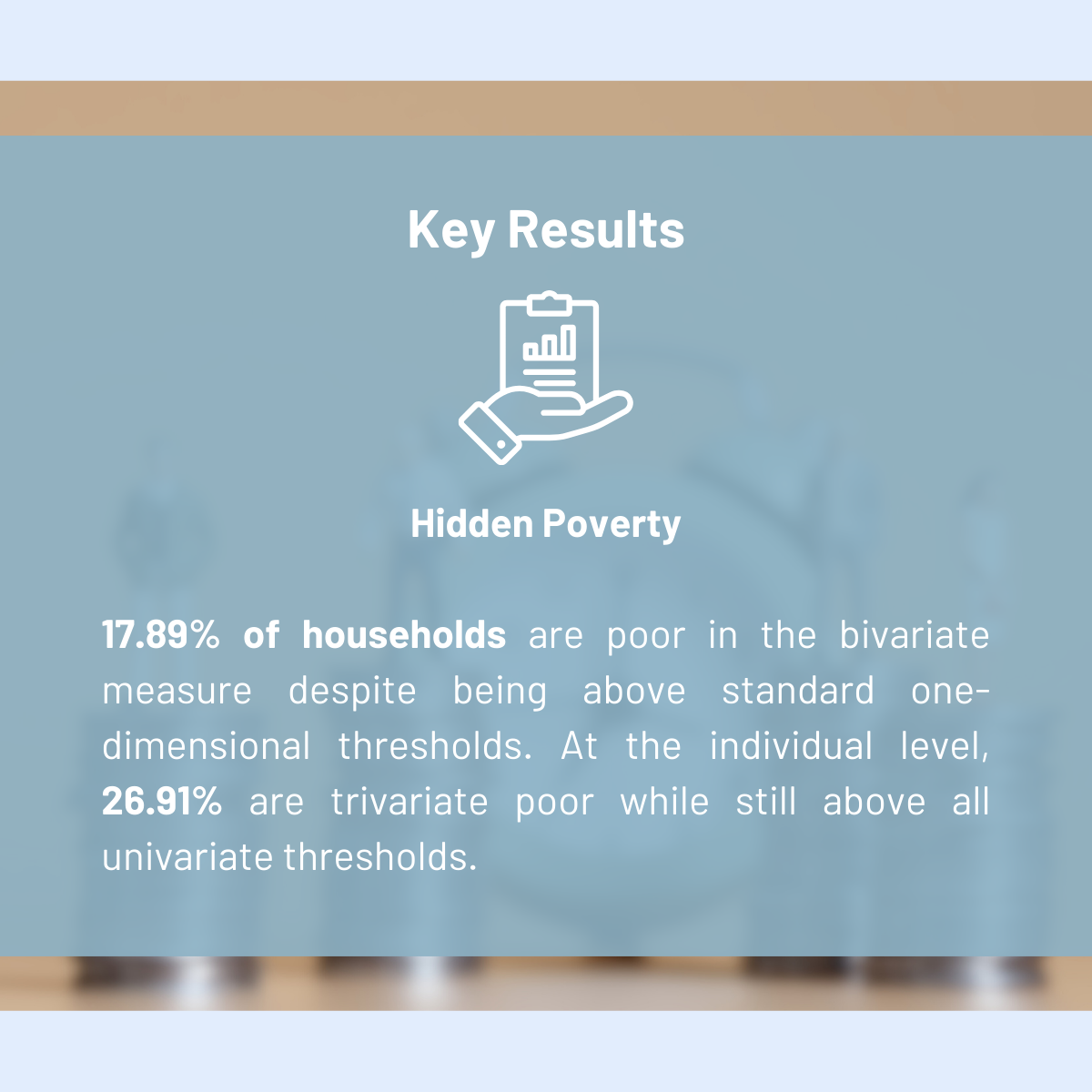
At the household level, 17.89% of households are classified as poor under the bivariate measure despite being above the separate income and unpaid work thresholds. These households are not poor by conventional definitions but face an insufficient combination of time and money.
At the individual level, the effect is even stronger. 26.91% of individuals fall below the trivariate poverty surface while remaining above all univariate thresholds. More than one in four people are therefore “hidden poor,” a group that becomes visible only through the new trivariate method.
The study also finds strong gender differences. Women carry higher unpaid work burdens and have less access to income. As a result, roughly one-third more women than men fall below the trivariate poverty surface.
Why the findings matter for policy
The study’s policy message: income support alone is unlikely to reduce poverty if time constraints remain unchanged.
Policies that focus only on earnings or employment may overlook unpaid work – especially care work – that limits real opportunities. By providing a method that makes time-related deprivation visible, the paper demonstrates that effective poverty reduction should address income poverty and time poverty together.
More broadly, the study demonstrates that how poverty is measured shapes what is recognized and addressed. By introducing a trivariate, distribution-sensitive measure, the authors show that poverty is not only about money, but about the daily constraints that structure people’s lives.
In short, the paper argues that societies may be underestimating poverty not because time is ignored conceptually, but because it has not yet been fully integrated into measurement – and this new method offers a way forward.
About the Authors
Franziska Dorn
Postdoctoral researcher at the Institute for Socioeconomics, University of Duisburg-Essen. Her research focuses on measuring living standards, with particular attention to time and income poverty, inequality, and sustainability using statistical methods beyond the mean.
Kim Sarah Meier
Researcher specialising in statistical methods and their application to the analysis of time use, income, and multidimensional poverty.
Simone Maxand
Junior Professor of Statistics at the European University Viadrina and Faculty Member at the Berlin School of Economics. Her work focuses on statistical methods applied to climate economics, sustainability, and distributional analysis.