Long-term care is becoming increasingly important as societies age, and its price matters for both families and public finances. A new study, “The Impact of Macroeconomic Conditions on Long-Term Care: Evidence on Prices” by Johannes Geyer, Peter Haan, and Mia Teschner, examines how regional economic conditions—measured by unemployment—affect the cost of institutional long-term care in Germany.
The central question is straightforward: do nursing home prices change when local unemployment rises, and if so, why? This matters because prices influence whether older people receive care in nursing homes, from ambulatory providers at home, or informally from family members. In Germany’s system of mandatory long-term care insurance, where prices are strongly regulated, it is not obvious that local business cycles should affect what nursing homes charge at all.
To answer this question, the authors use detailed administrative data on all nursing homes, ambulatory care services, and recipients of long-term care benefits in Germany between 2005 and 2015. These data include daily prices for different levels of care, as well as separate prices for accommodation and meals, information on staffing and working hours, and the number and impairment level of residents and home-care patients. They link this to district-level unemployment rates, which serve as a standard proxy for local macroeconomic conditions.
Methodologically, the study uses a panel data approach with “fixed effects” for facilities and years. This means the authors follow the same nursing homes over time and compare changes in their prices when unemployment in their district goes up or down, while controlling for stable differences between facilities and for nationwide trends. They also adjust for changes in the age structure of the district population, which could affect both unemployment and care needs. This strategy aims to isolate the effect of unemployment on prices from other factors.
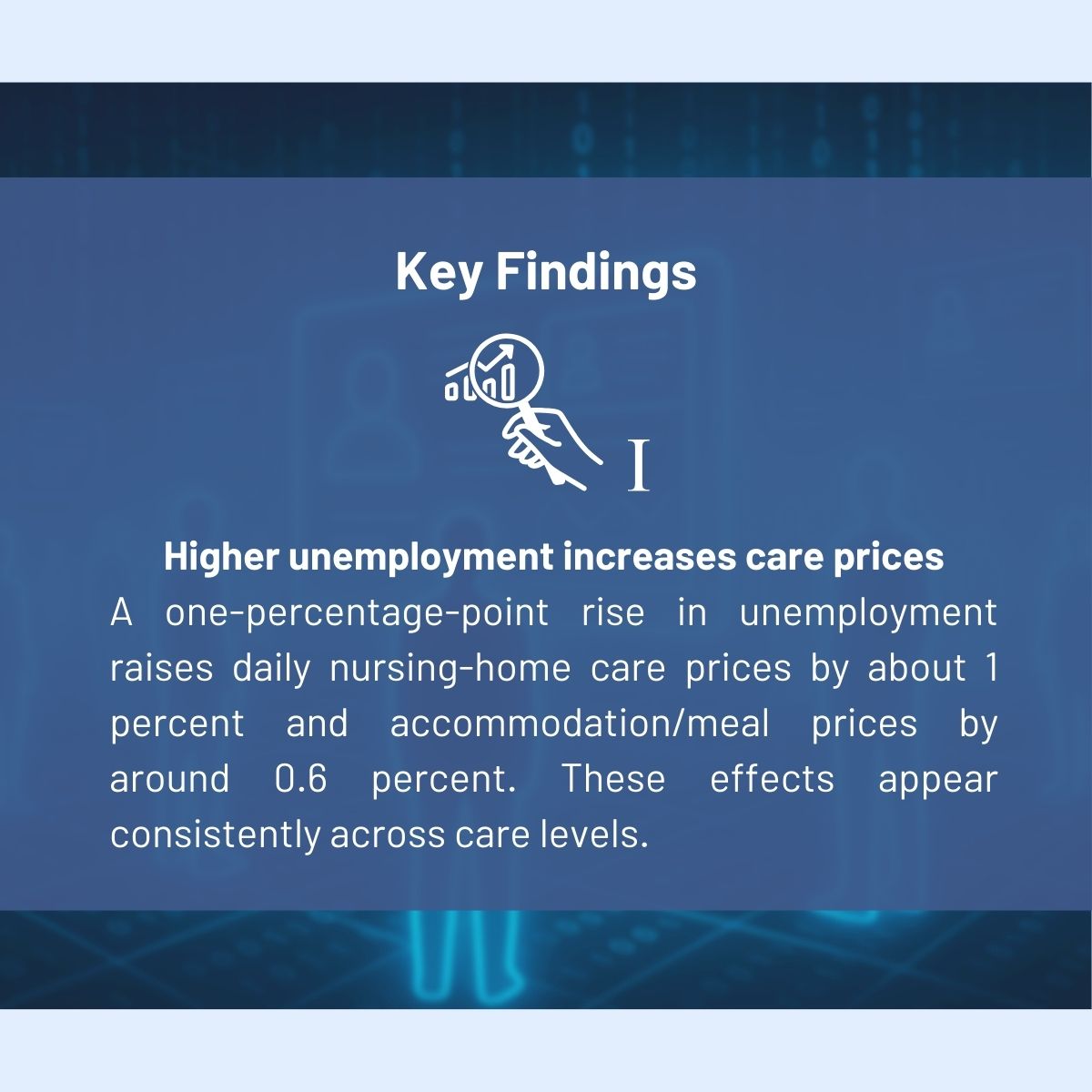
The results show a clear pattern: higher unemployment is associated with higher prices for permanent nursing home care and for accommodation and meals. A one-percentage-point increase in the local unemployment rate raises daily nursing home care prices by around 0.8 to 0.9 percent across all care levels, and the price for accommodation and meals by roughly 0.6 percent. Given that German long-term care prices are negotiated and tightly regulated, this responsiveness to the business cycle is notable.
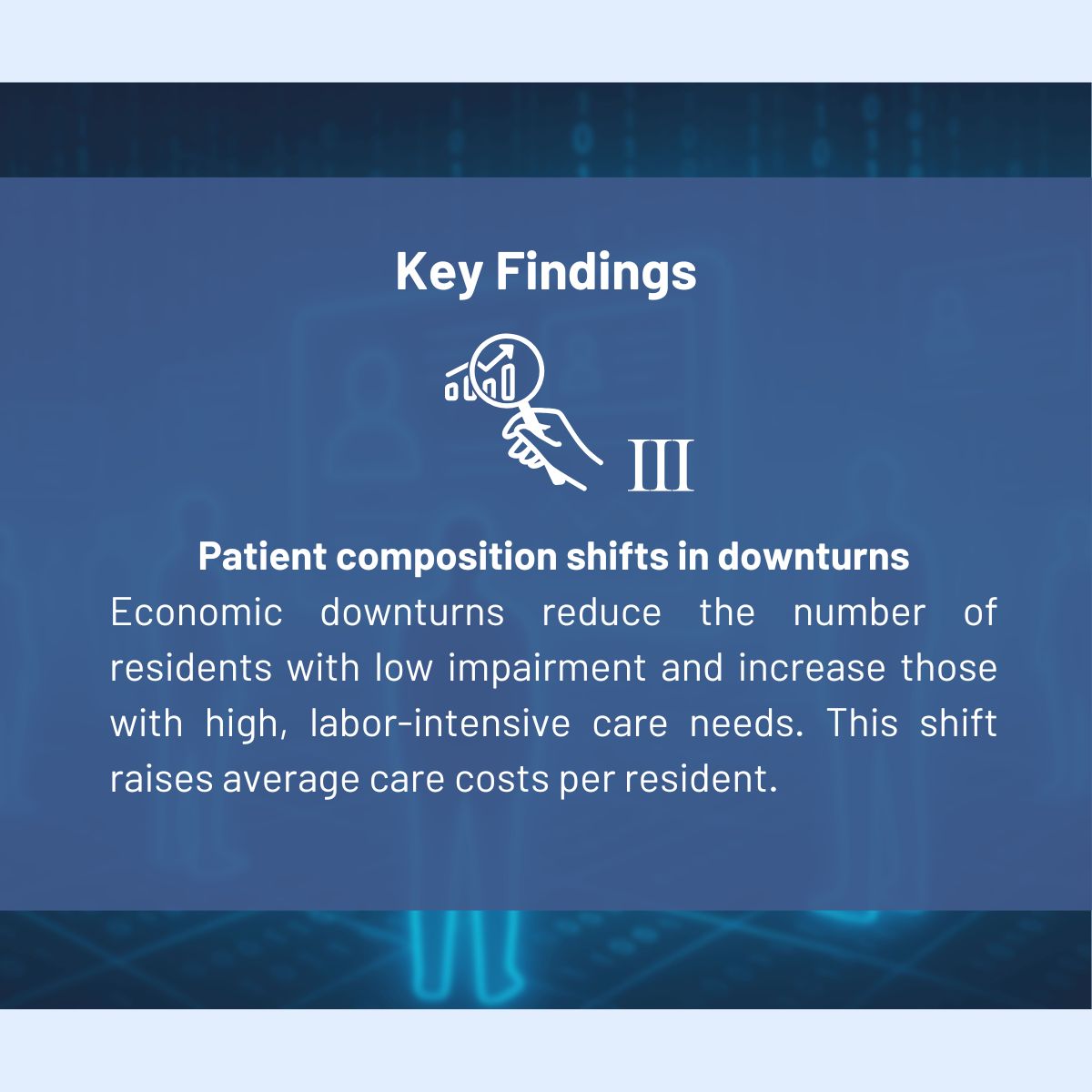
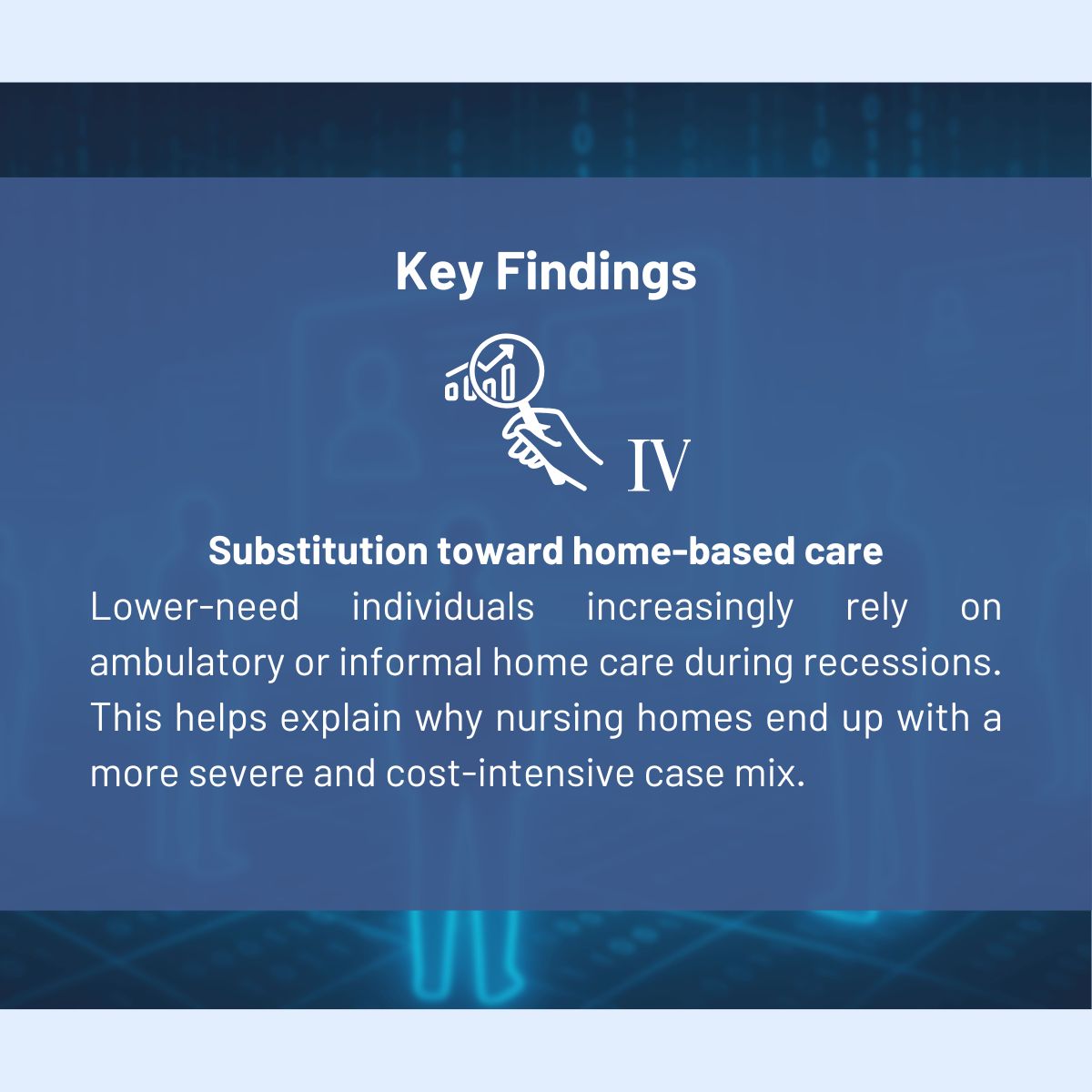
What drives these price increases? The study systematically tests several potential channels. It finds no evidence that higher unemployment leads to more staff, more working hours, or better staffing-related quality of care in nursing homes; employment levels and hours per resident remain largely unchanged. Instead, the main mechanism appears to run through the composition of patients and substitution between care types. When unemployment rises, the number of residents with lower impairment levels declines, while the number with severe, labor-intensive care needs increases. At the same time, use of ambulatory and informal home care grows, especially among those with lower care needs. In other words, economic downturns shift relatively “lighter” cases out of nursing homes and into home-based and informal care, leaving nursing homes with a more demanding and costly case-mix, which in turn pushes up prices.
The broader implications are important for long-term care policy and social protection. First, the findings show that regulated prices in publicly financed systems still react to the economic environment, once we account for changes in who is being cared for where. Second, economic downturns do not just affect employment and incomes; they also reshape the balance between institutional, ambulatory, and informal care. This may increase the burden on families during recessions, while raising public and private spending on those who remain in institutional care. Finally, as ageing and long-term care costs continue to rise, the study underlines the need to consider macroeconomic conditions when planning funding rules, benefit levels, and support for informal caregivers.
About the Authors
Johannes Geyer
Deputy Head of the Public Economics Departmentat the German Institute for Economic Research (DIW Berlin). His research topics and working areas are retirement and pension provision, health, long-term care, demographic Change, microsimulation and old age poverty.
Peter Haan
Head of department of Public Economics at DIW Berlin and Professor of Public Economics at Freie Universität Berlin. Ph.D in Economics. Studies in Economics and Political Sciences at Albert-Ludwigs-University Freiburg, Humboldt-University Berlin and University of Toronto. Visiting Fellow at Paris School of Economics, Institute for Fiscal Studies und UCL London. Recent publications in Journal of Econometrics, Journal of Public Economics, Economic Journal, Journal of Health Economics and Econometrics Journal.
Mia Teschner
Research Associate of the Public Economics Department at DIW Berlin. Her research popics and working areas are labor and employment, health, applied microeconometrics, long-term care and retirement and pension provision.