
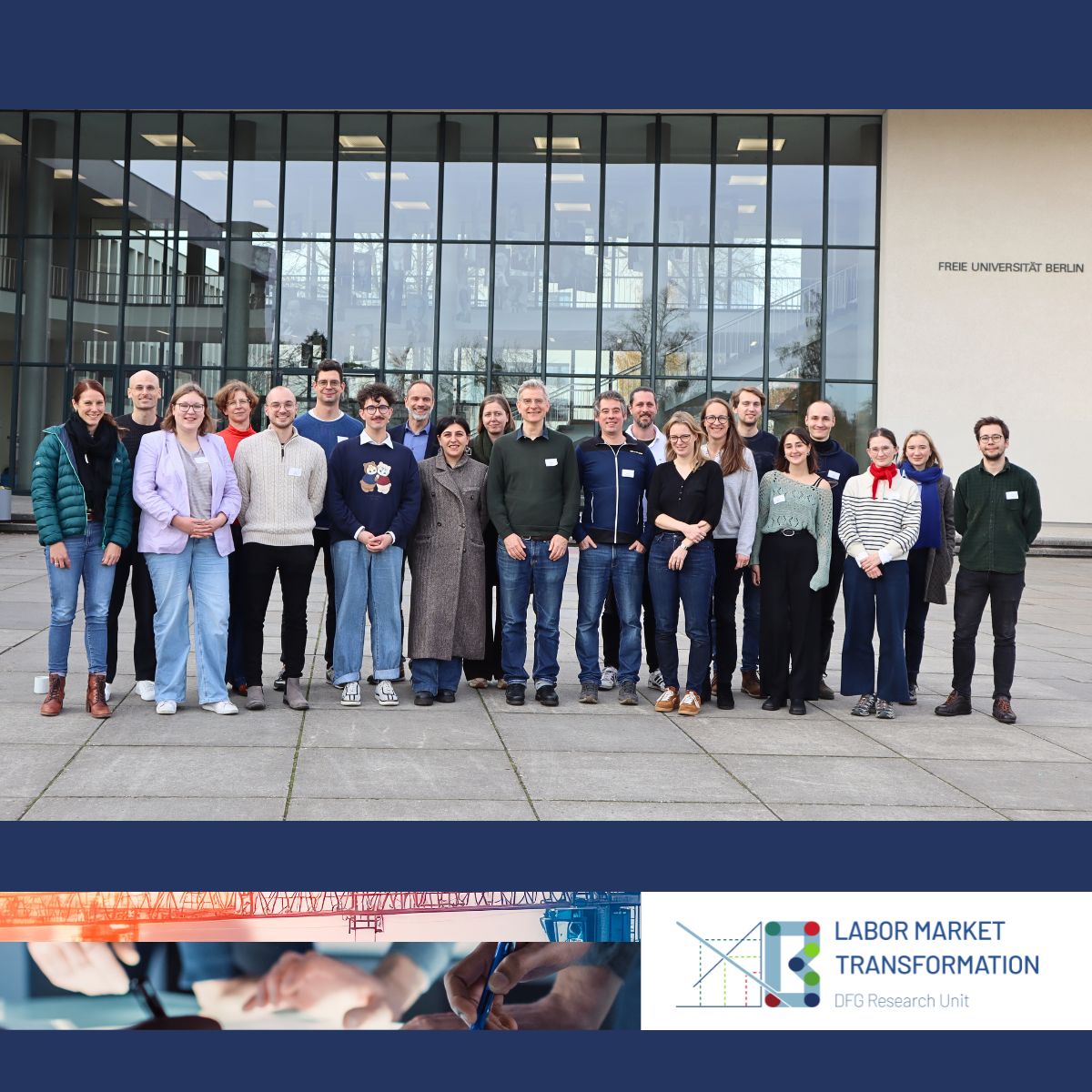
The newly funded DFG Research Unit “Labour Market Transformation: Scarcity, Mismatch & Policy” convened its first internal workshop at Freie Universität Berlin last week. Researchers from across the nine partner institutions of the Berlin School of Economics came together to present the progress made during the Unit’s first research year.
The Research Unit investigates how demographic change, digitalization, and climate policies jointly reshape labor markets. The projects examine which skills are in short supply, how firms and workers adjust, and what role policy can play in easing workforce shortages. The Unit focuses on structural forces such as population ageing, the digital transformation and artificial intelligence, as well as the transition to a greener economy and related regulatory changes, including the EU Green Deal. These dynamics affect labor demand and skill requirements across sectors and can widen the gap between needed and existing qualifications.
The workshop opened with Shushanik Margaryan (University of Potsdam; IZA), who presented her work on Affirmative Action during Early Childhood: School Choice, Academic Performance and School Satisfaction. As a co-PI in the Research Unit, Margaryan specializes in applied microeconomics with a focus on the economics of education, labor, and health. Her project examines how targeted early-childhood policies shape school choices, learning outcomes, and subjective well-being—thereby speaking directly to how education policy can alleviate future skill shortages and promote equal opportunities from the very start of the life course.
Next, Mia Teschner (DIW Berlin; Freie Universität Berlin) discussed Working Longer: The Effects of a Higher Retirement Age on Work-Related Health Investments During the Working Life. Her research uses pension reforms to study how extending working lives affects both labor supply and health-related behavior. This line of work is central to the Research Unit’s interest in demographic change: when retirement ages increase, workers may adjust their investments in health and human capital in ways that shape both productivity and the sustainability of labor supply at older ages.
Alexandra Spitz-Oener (Humboldt-Universität zu Berlin; ROCKWOOL Foundation Berlin) followed with a talk on “AI and the Firm-Level Nature of Work.” Spitz-Oener’s research has long examined how technological change and automation transform tasks, job content, and skill demands, including work on task change, technology adoption, and educational requirements.
In the late morning, Felix Weinhardt (Europa-Universität Viadrina; DIW Berlin; CESifo; IZA) followed with “Random Placement, real Bias.” Weinhardt’s research in applied econometrics focuses on social and spatial inequality, particularly in education, labor, and housing markets. All of his work speaks to contemporaneous public debates and policy.
After lunch, Mareen Bastiaans (Europa-Universität Viadrina) spoke on Turning the Tide: Long-Term Gains of Graduating in a Recession for Low Educated Entrants. Her research estimates long-run effects of labor market entry conditions on earnings and employment, distinguishing between low- and high-educated workers and tracking outcomes over several decades. Earlier work shows that graduating in a recession can have persistent consequences, but Bastiaans’ current project highlights that under certain conditions, low-educated workers may experience long-term gains if adverse entry conditions trigger specific forms of mobility or policy interventions.
Katrin Huber (University of Potsdam; CEPA; IZA) then presented When Managers Choose: Gender Disparities in Employer Training Provision. Using a discrete choice experiment with managers, this project examines how gender influences firms’ decisions to offer on-the-job training, holding constant other characteristics such as competence, mobility, and age. The findings highlight how biases or structural constraints in firms’ training provision can reinforce gender gaps in skill development and career progression.
In the afternoon, Britta Gehrke (Freie Universität Berlin; IAB; IZA) presented joint work on Unemployment Benefits and Interest Rates: The Role of Age. Gehrke, a macroeconomist specializing in the interplay of labor markets, business cycles, and policy, studies how changes in unemployment benefits affect not only employment but also macroeconomic variables such as real interest rates. Her research shows that benefit cuts can lower real interest rates and that employment effects vary across age groups, with younger workers often benefiting more than older ones.
Jan Nimczik (ESMT Berlin, RFBerlin, IAB, IZA) continued the program with Multiple Career Ladders within Organizations. Nimczik’s broader work on internal labor markets uses detailed worker-flow data to map how employees move between positions inside firms and how these movements shape wage dynamics and career progression. His talk examined how firms with several distinct internal career ladders allocate workers across tracks and how this structure influences promotion opportunities, productivity, and retention.
Later in the day, Katharina Wrohlich (University of Potsdam; DIW Berlin; IZA) presented “Gender Gaps in Justice Perceptions of Wages: The Effect of Parenthood and Employment Biographies (Work in Progress).” As head of the Gender Economics Research Group at DIW Berlin and professor of public finance, gender, and family economics, Wrohlich has long studied gender gaps in employment, working hours, and wages.
In the final presentation, Peter Haan (Freie Universität Berlin; DIW Berlin) spoke on “Income Effects of a Parental Health Shock: the role of informal long-term care.” Haan, professor of public economics and head of the Public Economics Department at DIW Berlin, has extensively studied social policy, pension reforms, and the distributive consequences of demographic change. His workshop contribution analyzed how sudden health shocks to parents affect household incomes and labor supply decisions through the channel of informal care. This connects questions of long-term care, social insurance, and labor supply.
Taken together, the workshop underscored how the DFG Research Unit integrates micro- and macro-level perspectives, firm behavior and individual decisions, and questions of gender equality, education, and demographic change. It also highlighted the strength of Berlin’s research network. The coming years promise a rich set of findings on how policies in education, immigration, family and pension systems can help mitigate workforce shortages and better align skills with the needs of a transforming economy.


