Educational setbacks early in life can have long-lasting consequences, especially for students who struggle at school and face difficult transitions into work or vocational training. A new study asks whether online tutoring can help close this gap by supporting not only learning at school, but also the move from school into the labor market.
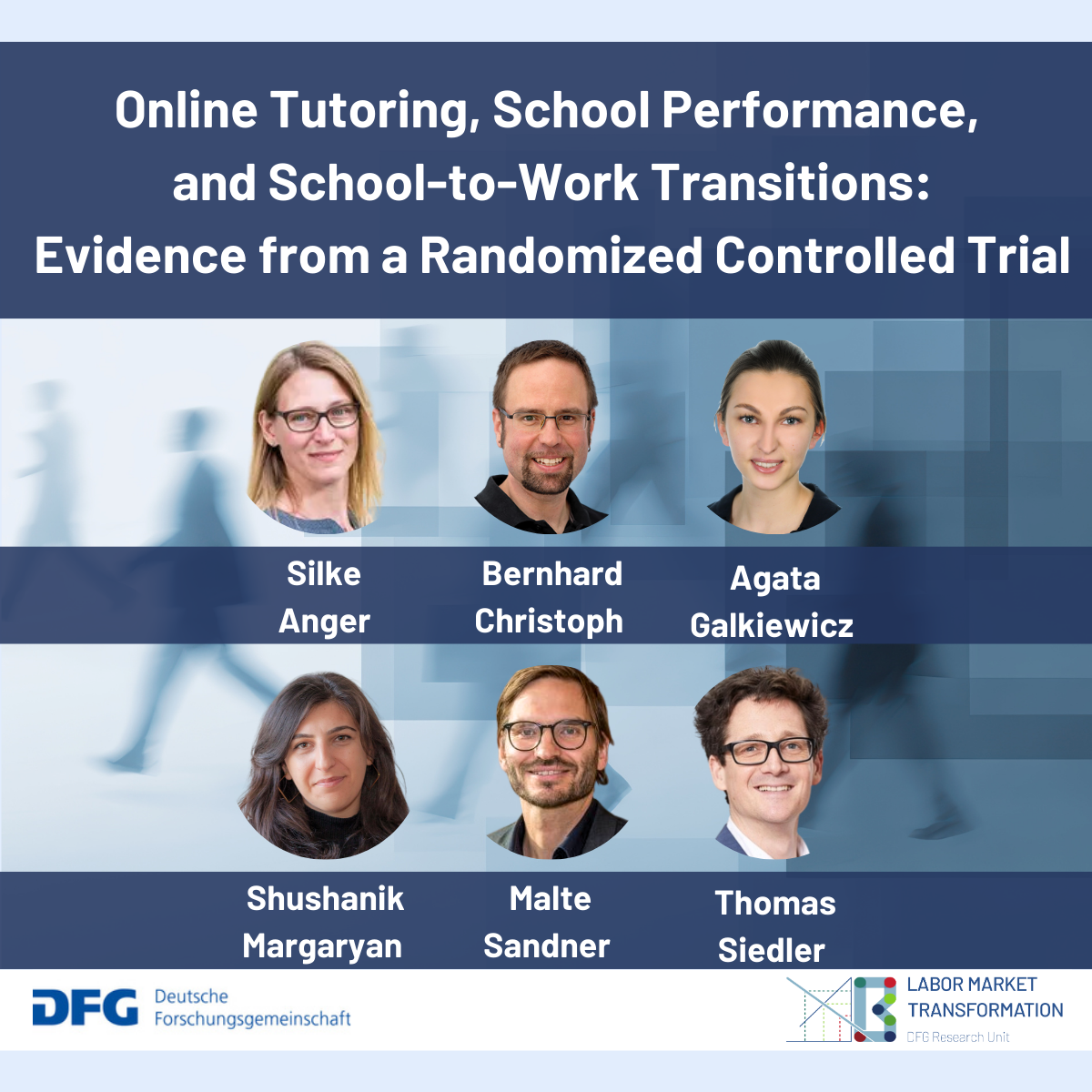
In Online Tutoring, School Performance, and School-to-Work Transitions: Evidence from a Randomized Controlled Trial, Silke Anger, Bernhard Christoph, Agata Galkiewicz, Shushanik Margaryan, Malte Sandner, and Thomas Siedler examine whether one-on-one online tutoring for low-performing students improves academic outcomes and early career pathways. The central question is straightforward but important: can a relatively light, scalable educational intervention create benefits that extend beyond grades?
Tutoring programs are widely used to support struggling students, and many studies show that they can improve short-term academic performance. However, much less is known about whether these improvements matter once students leave school. This gap is particularly relevant in countries like Germany, where early educational pathways strongly shape access to vocational training and future employment opportunities.
To address this question, the researchers conducted a randomized controlled trial, a method often considered the gold standard for causal analysis. In simple terms, students were randomly divided into two groups: one group received an invitation to participate in free online tutoring, while the other did not. Because assignment was random, differences in later outcomes can be attributed to the tutoring offer rather than to background characteristics.
The study followed 839 secondary school students across Germany, most of whom were low-performing and from disadvantaged backgrounds. The tutoring program was delivered by the nonprofit organization Lern-Fair and connected students with university volunteers for regular online sessions. Importantly, this was not a small pilot project but a program already operating at scale, which makes the findings especially relevant for policy.
The researchers tracked outcomes at two points in time. After six months, they measured school performance, focusing mainly on math grades and grade repetition. After eighteen months, they examined what students were doing after leaving school, such as entering vocational training, remaining in transitional programs, or leaving education without a clear next step.
The results on grades are nuanced. On average, the tutoring offer led to small improvements in math grades, but these were not statistically significant for the full sample. However, for students who had not received any tutoring before the program, the effects were larger and clearly positive. For this group, online tutoring significantly improved math performance and reduced the likelihood of repeating a grade.
More striking are the findings on school-to-work transitions. Among students in non-academic school tracks, those who received the tutoring offer were more likely to enter vocational training eighteen months later. At the same time, they were less likely to remain in the so-called transition system—programs that often delay entry into formal training and are associated with weaker long-term prospects.
To better understand how these effects arise, the study also examined possible mechanisms. The researchers looked at changes in motivation, study time, well-being, perseverance, and educational aspirations. They found no meaningful effects on any of these dimensions. Students did not report studying more, feeling more motivated, or changing their career plans.
This helps clarify where the benefits come from. The tutoring did not change how students felt or what they wanted to do. Instead, it appears to have improved how effectively they learned. In practical terms, students gained a better understanding of school material during the time they were already studying. These small academic improvements then mattered at key institutional thresholds, such as applications for vocational training, where grades serve as an important formal signal.
From a policy perspective, these findings are highly relevant. They suggest that online tutoring can support disadvantaged students in a cost-effective and scalable way, even without transforming attitudes or behavior. Small improvements in academic performance can have meaningful consequences when education systems rely on formal credentials and grades to allocate opportunities.
At a time when many governments are investing heavily in tutoring programs to address learning losses and inequality, this study provides rare evidence that such interventions can have effects beyond the classroom. By helping students move more smoothly from school into vocational training, online tutoring may contribute to more stable early career paths and better long-term outcomes.
About the Authors
Silke Anger
Senior researcher at the Institute for Employment Research (IAB) and professor at the University of Bamberg. Her research focuses on labor economics, education, and social inequality.
Bernhard Christoph
Researcher at the Institute for Employment Research (IAB). His work centers on labor market policy, education, and social mobility.
Agata Galkiewicz
Researcher at the University of Potsdam and the Institute for Employment Research (IAB). Her research interests include education economics and labor market transitions.
Shushanik Margaryan
Postdoctoral fellow at the University of Potsdam and research fellow at IZA. Co-PI at DFG Research Unit on Labor Market Transformations. Her research interests are in applied microeconomics, particularly economics of education, labour economics, and health economics.
Malte Sandner
Professor at Nuremberg Institute of Technology for „Data Sience and Empirical Economics“ and researcher at IAB and IZA. His research focuses on topics in applied microeconomics with an emphasis on education, health, family, and migration economics.
Thomas Siedler
Professor at the University of Potsdam, Research Associate at the Institute for Social and Economic Research (ISER), University of Essex, as well as a Research Fellow at IZA in Bonn. He was responsible for developing the innovative e-learning website www.mcempirics.com which comprises over 1,000 introductory econometric questions and answers. Teachers can quickly and easily create tests using mcEmpirics extensive library of questions.