Women remain underrepresented in senior academic positions across Europe and beyond. A new study shows that parenthood plays a central role in explaining why.
In the paper Parenthood and the Career Ladder: Evidence from Academia, Sofie Cairo, Ria Ivandić, Anne Sophie Lassen, and Valentina Tartari examine how becoming a parent affects careers in academia. Their central question: Do motherhood and fatherhood have different consequences for staying in academia and reaching senior positions?
This question matters because academia shapes research, education, and public debate. If women are more likely to leave academic careers after having children, this affects not only gender equality but also who produces knowledge and holds leadership roles in science.
To answer their question, the researchers use detailed administrative data from Denmark. The data cover the full population of individuals who have ever enrolled in a PhD program between 1996 and 2017. These records are linked to information on employment, earnings, academic rank, publications, and family formation.
The study follows researchers over time and compares their career paths before and after the birth of their first child. The authors use an event-study design, a method that tracks outcomes around a specific event – in this case, childbirth – while accounting for age, calendar year, and career stage. This allows them to isolate the impact of parenthood on academic employment, tenure, and research output.
Before parenthood, men and women follow very similar career trajectories. They have comparable employment rates in universities and similar chances of reaching tenure, which is a permanent senior position such as associate professor or full professor.
After the first child is born, their paths diverge sharply.
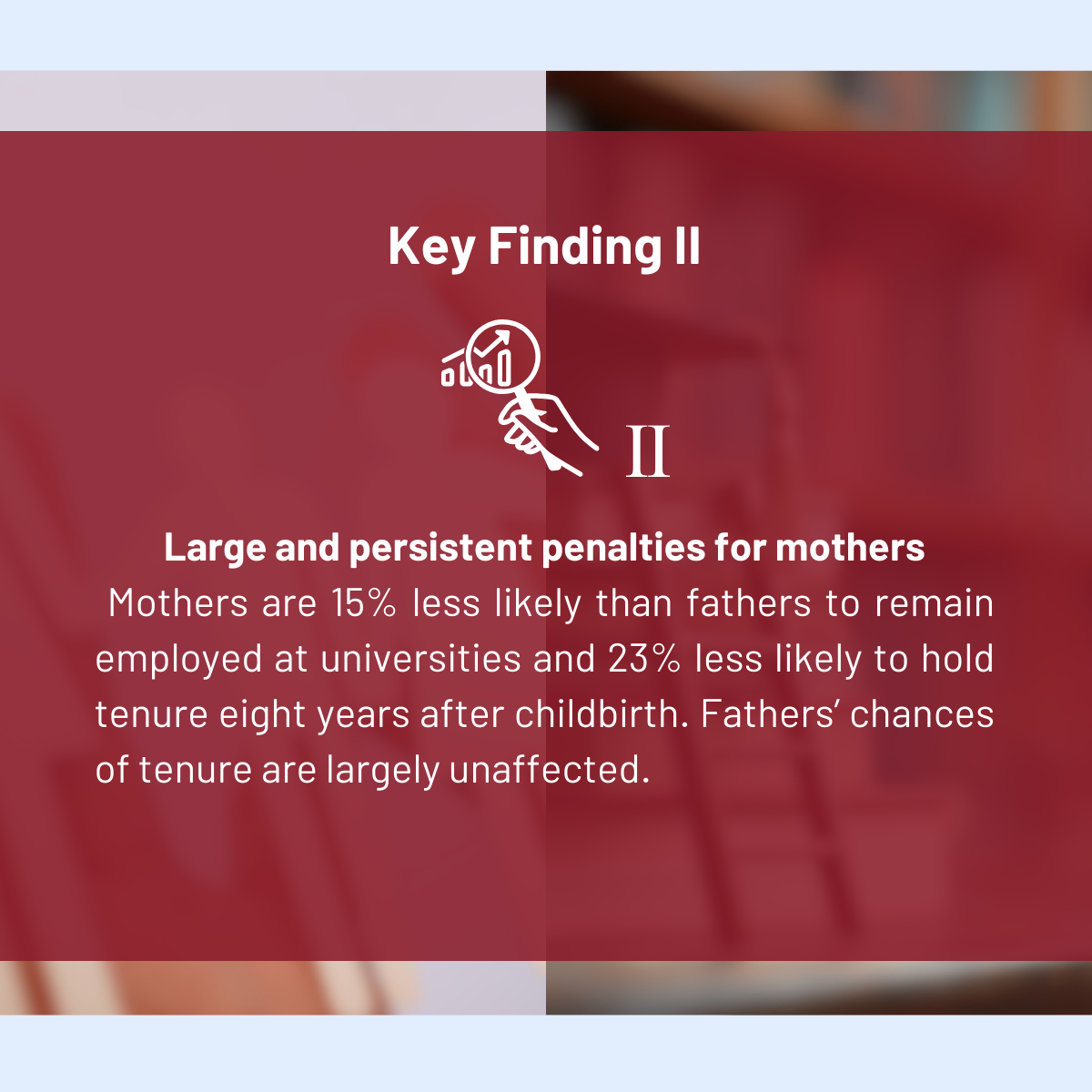
One in three women leaves academia following motherhood. Eight years after the first child, mothers are 15 percent less likely than fathers to be employed at a university. This difference accounts for a large share of the overall gender gap in academic employment.
The divergence is even more pronounced when it comes to tenure. While fatherhood has no measurable effect on men’s chances of becoming tenured, mothers experience a persistent decline. Eight years after childbirth, women are 23 percent less likely than men to hold a tenured position.
Research productivity also changes. Mothers publish less after childbirth, both in terms of the number of publications and when adjusted for journal quality. Fathers’ publication records remain largely unaffected.
Importantly, the study shows that most of the tenure gap is driven by women leaving academia rather than only by slower career progression within academia. When women exit academic employment, they also exit the tenure track. This early exit is a key reason why fewer women reach senior positions later on.
How can we explain these results?
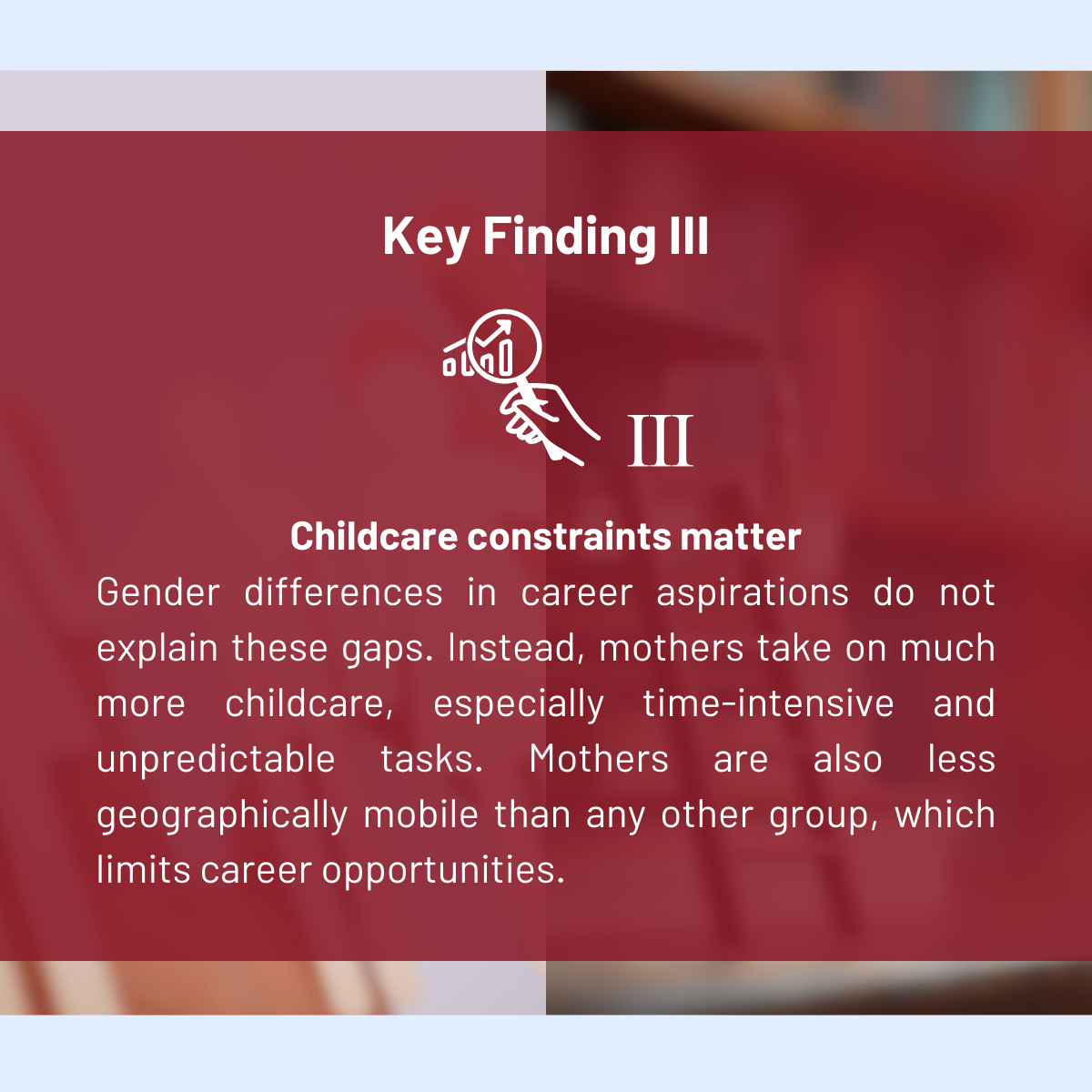
The authors also investigate possible explanations. One hypothesis is that women and men differ in career aspirations. Survey data from academics and PhD students show no such gap. Men and women express similar interest in research careers and similar views on the job-amenities within academia.
Another explanation concerns childcare responsibilities. The survey reveals large gender differences in who takes on childcare, especially time-intensive and unpredictable tasks such as caring for sick children or getting up at night. These responsibilities can reduce working hours and ability to work focused and uninterrupted.
The study also examines whether supportive family arrangements reduce the penalty. For example, it looks at whether having a partner with a PhD, taking paternity leave, or having access to retired grandmothers changes the outcomes. These factors do not appear to sufficiently alleviate the childcare constraint of mothers and, in turn, do not substantially reduce the motherhood penalty.
However, workplace characteristics matters. Women trained in departments without senior female role models face larger penalties. Similarly, highly competitive and research-intensive departments are associated with stronger negative effects of parenthood on women’s tenure prospects.
Parenthood – a major driver of gender inequality in academia
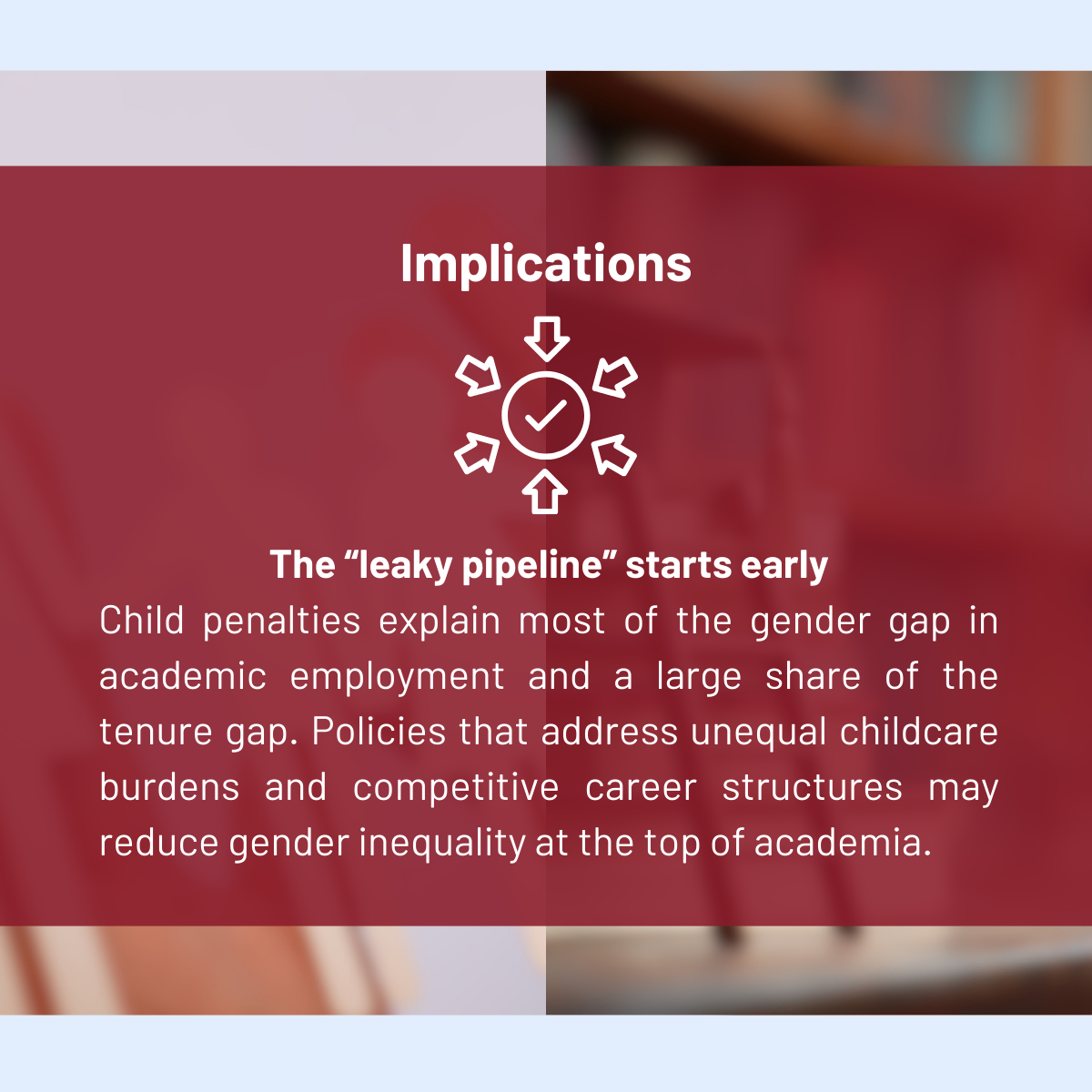
Overall, the findings suggest that parenthood is a major driver of gender inequality in academia. Child penalties explain around 70 percent of the gender gap in academic employment and about 40 percent of the gap in tenure.
The broader significance: If academic careers are structured in ways that make parenthood particularly costly for women, this shapes who remains in research and who advances to leadership roles. Addressing unequal childcare responsibilities and rethinking career structures may therefore be central to reducing gender gaps at the top of academia.
By linking detailed population data with publication records and survey evidence, the study provides a clear picture of when and how the “leaky pipeline” begins. The results show that gender inequality in academia is not only a matter of preferences or performance. It is closely tied to the transition to parenthood – and to the structures that shape careers at that moment.
About the Authors
Sofie Cairo
Assistant Professor at Copenhagen Business School and affiliated with the University of Zurich. Her research focuses on gender and the economics of science.
Ria Ivandić
Assistant Professor at the University of Zagreb and Associate Researcher the London School of Economics. Her work examines labour economics, political economy and the economics of crime.
Anne Sophie Lassen
PostDoctoral Research Fellow at WZB Berlin Social Science Center and part of the Berlin School of Economics. She studies the mechanisms behind and implications of gender differences in labor market outcomes.
Valentina Tartari
Professor at the Stockholm School of Economics and Copenhagen Business School. Her research centers on the determinants of knowledge production and transfer, inside and outside academia.